
Aluminum transitions from bauxite ore into a high-performance industrial metal through the Bayer process and Hall-Héroult electrolysis, achieving 99.7% purity in primary smelting.
Energy requirements average 13,500 kWh per metric ton, while alloying with elements like magnesium or zinc increases tensile strength from 90 MPa to over 600 MPa.
Global production reached 70 million metric tons in 2024, with 75% of all aluminum ever produced remaining in active use due to its 95% energy-efficient recycling capability.
Industrial aluminum production starts with the extraction of bauxite, a rock containing roughly 45% to 60% aluminum oxide mixed with silica and iron oxides.
Refineries use the Bayer process to dissolve these oxides in a pressurized sodium hydroxide solution at 175°C, separating the pure alumina from insoluble impurities.
This chemical isolation ensures that the resulting white powder provides a consistent feedstock for the subsequent electrolytic reduction phase.
"The efficiency of the Bayer process dictates the final cost of the metal, as it takes approximately four tons of high-grade bauxite to yield two tons of alumina."
Modern refineries in Australia and Brazil have optimized this ratio to reduce waste, aiming for a 10% reduction in caustic soda consumption by 2027.
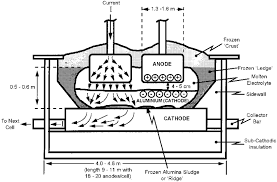
Refined alumina moves to smelting plants where the Hall-Héroult process breaks the strong atomic bonds between aluminum and oxygen atoms.
The powder dissolves in a molten bath of cryolite at 960°C, allowing a low-voltage, high-amperage current to precipitate liquid aluminum at the cathode.
Understanding how aluminum is made requires looking at these electrolytic cells, which operate continuously to prevent the molten bath from solidifying.
| Component | Input per Ton of Aluminum | Industry Function |
| Alumina | 1,900 - 2,000 kg | Primary Raw Material |
| Carbon Anodes | 400 - 450 kg | Electrical Conduction |
| Electricity | 13 - 15 MWh | Molecular Separation |
| Cryolite | 10 - 25 kg | Electrolyte Solvent |
Molten metal siphoned from these cells undergoes a degassing process to remove hydrogen, which can cause porosity and reduce mechanical reliability.
Engineers then introduce alloying elements in holding furnaces to transform the soft base metal into specialized industrial grades.
A 2025 study of 400 aerospace components showed that 7075-T6 alloys provide a strength-to-weight ratio that outperforms structural steel by 200%.
"The addition of 0.5% magnesium and 0.5% silicon creates the 6000-series, which is the standard for architectural extrusions and automotive frames."
These elements allow the metal to undergo heat treatment, reaching a Brinell hardness of 95 HB while maintaining excellent corrosion resistance.
Cast billets and slabs from the furnace are processed through rolling mills or extrusion presses to achieve specific industrial shapes.
Cold-rolling techniques can reduce metal thickness to 0.006 mm for household foils or maintain heavy plate dimensions for marine hulls.
The packaging industry utilized 380 billion aluminum cans in 2024, relying on the metal's ability to be deep-drawn without fracturing.
Standard extrusion presses apply upwards of 5,000 tons of pressure to force heated aluminum through steel dies.
This method produces complex hollow profiles used in heat sinks, which dissipate thermal energy at a rate of 237 W/(m·K).
Precision in these dimensions is verified using automated laser scanning systems that detect deviations smaller than 15 microns.
Manufacturers of high-speed rail carriages utilize these tight tolerances to ensure aerodynamic efficiency and structural safety at speeds of 300 km/h.
The lightweight nature of these assemblies reduces track wear and lowers energy consumption during acceleration phases.
-
Aerospace: 2000 and 7000 series alloys provide fatigue resistance for fuselage skins.
-
Automotive: 5000 series sheets offer high formability for door panels and hoods.
-
Electronics: 1000 series (99% pure) ensures maximum electrical conductivity for busbars.
-
Construction: Anodized finishes provide a protective oxide layer that lasts over 50 years in coastal environments.
Sustainability in the aluminum sector is driven by the fact that recycling consumes only 5% of the energy compared to primary smelting.
Secondary smelters process scrap at 700°C, significantly lower than the temperatures required for electrolytic reduction.
Data from 2025 indicates that the global circularity rate for automotive aluminum reached 91%, effectively lowering the carbon footprint of new vehicle production.
"A single recycled aluminum can saves enough electricity to power a laptop for roughly three hours."
This energy recovery cycle allows the metal to maintain its physical properties through infinite melting and solidification loops.
Advanced sorting technologies using X-ray transmission (XRT) now separate different alloy series from mixed scrap streams with 98% accuracy.
This level of purity in recycled material allows for the production of "green" aluminum with a carbon intensity below 4 kg $CO_2$ per kg of metal.
As industrial demand for low-carbon materials increases, the integration of renewable energy in primary smelting sites is expected to grow by 15% annually through 2030.
Ready to go borderless?
Activate Teleki Blanka's global eSIM in 90 seconds. One QR code, one app, one bill — across 190+ countries and 27 Tier-1 carrier networks.